
Address: 6km South of Watton on the A1075 Thetford to Watton Road, just north of the village of Stoke Bedon
What3Words: boomer.bypasses.conjured
Accessibility: Amber – most paths are rough tracks
Free to park and free to enter, Thompson Common which is owned and maintained by the Norfolk Wildlife Trust is one of the county’s better kept secrets.
The Common is a combination of both dry and wet grassland. As well as this you will also find plenty of heathland with rough scrub, some truly impressive mature woodland and also many scattered pools.
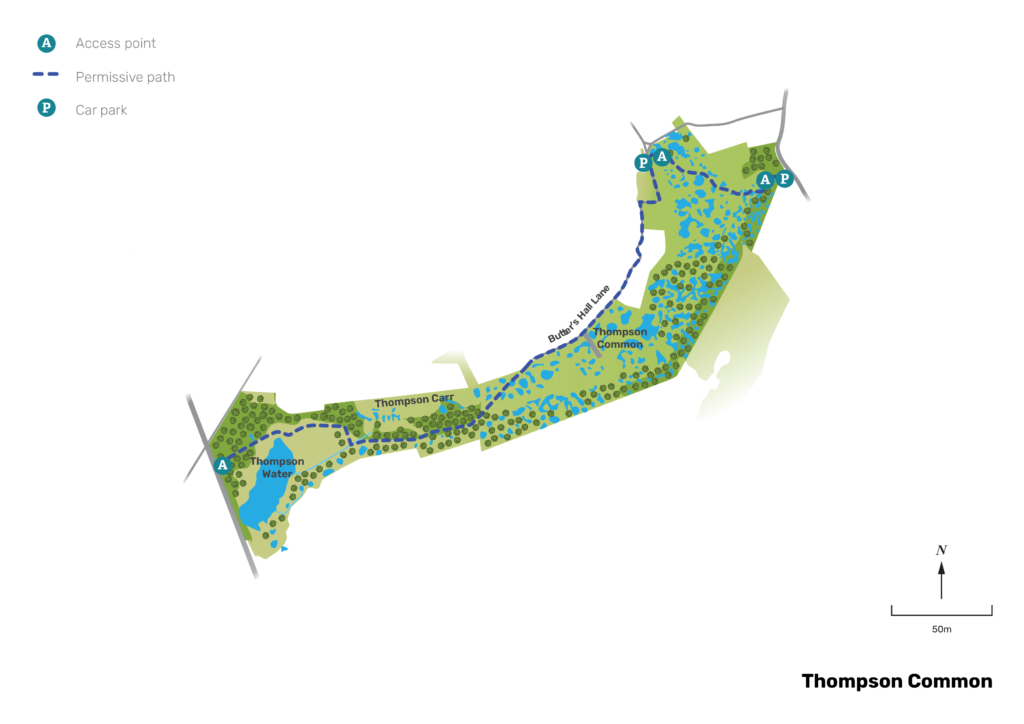
A permissive path can be found that goes across the common. This path is one that is a section of the wider Pingo Trail across the region.
Wildlife can be seen grazing at various times throughout the year on the common. And you will find a diverse selection of species present at Thompson Common. Roe dear can be seen year round here at the right time of day. In the summer months it is an important site for damselflies as well as dragonflies. A wide selection of beetles and butterflies also being found on Thompson Common in season.
Conservation
The site is designated as a Site of Special Scientific Interest (SSSI). As well as this it is also has a “Special Areas of Conservation (SAC)” designation. The conservation interest comes from two factors associated with Thompson Common
The northern pool frog, which is said to be the UK’s rarest amphibian. The northern pool frog is believed to have gone extinct in the wild in the UK towards the end of the 20th century. The last known colony said to have been found on Thompson Common. In 2021, the Norfolk Wildlife Trust (NWT) working in conjunction with the Amphibian and Reptile Conservation managed to end their extinction period in the UK. They successfully managed to re-introduce a number of northern pool frogs to Thompson Common. All of which was done by means of frogs which were imported to the UK from Sweden .
Thompson Common is also celebrated for its impressive pingo pond formations. Pingos are small tundra hillocks that were formed in the earth during the previous Ice Age. They occurred through natural spring water that was seeping upwards into the environment. This then reached the permafrost and consequently proceeded to instantly freeze. As such this led to the creation large ‘lens’ like structures of ice. Arguably similar in appearance to a blister on the landscape.
After the ice had gone on to melt, the ‘blisters’ then collapsed to form a hollow in the surrounding landscape. You can still to this day see these features when visiting Thompson Common along with the springs which originally helped create them. These springs still feed the water that supplies the same pingo ponds to this day


Leave a Reply
You must be logged in to post a comment.